

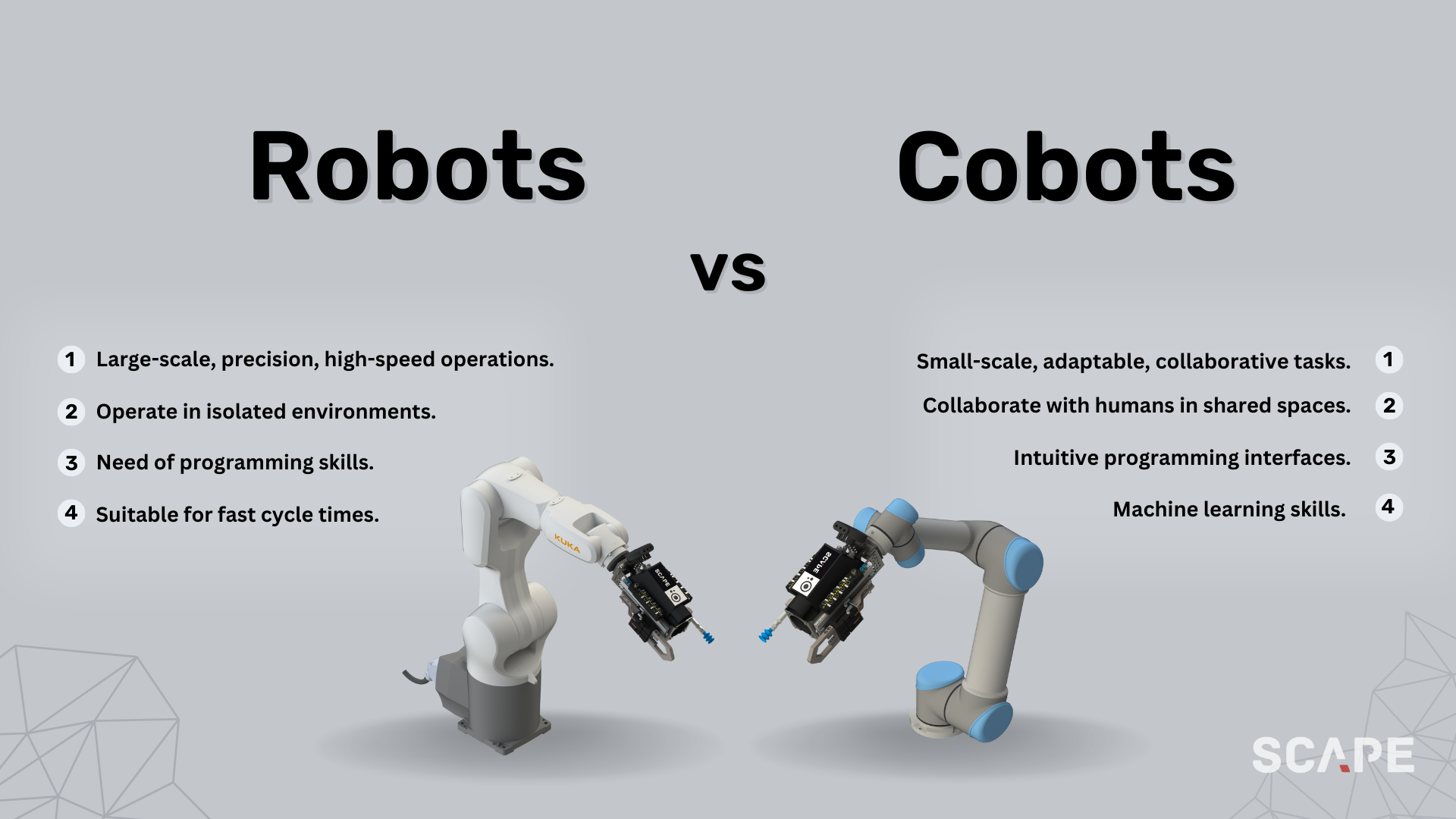
A cobot (collaborative robot) is designed to work safely alongside human operators without safety cages, while an industrial robot operates in isolated, high-speed environments with strict fencing. Understanding the differences between these two robotic categories is essential for any company evaluating automation investments, as the choice directly impacts safety compliance, floor layout, task suitability, and total cost of ownership.
- What Is a Cobot? — Definition and Core Characteristics
- How Does an Industrial Robot Differ from a Cobot?
- How Do Cobots Work? — Key Technologies and Safety Features
- What Are the Primary Use Cases for Cobots vs Industrial Robots?
- What Should You Consider When Buying a Cobot?
- Cobot vs Industrial Robot — Quick Comparison Table
- Frequently Asked Questions
What Is a Cobot? — Definition and Core Characteristics
A cobot, or collaborative robot, is a robotic arm designed for direct interaction with human workers in a shared workspace. Unlike traditional industrial robots that operate behind safety barriers, cobots incorporate force-limiting sensors, rounded edges, and speed monitoring to prevent injury. The International Organization for Standardization (ISO) defines cobot safety under ISO/TS 15066, which specifies four collaborative operation modes: safety-rated monitored stop, hand-guiding, speed and separation monitoring, and power and force limiting. Cobots typically have lower payload capacities (3–16 kg) and slower speeds (≤250 mm/s) than their industrial counterparts, making them ideal for tasks like assembly, machine tending, and quality inspection.

How Does an Industrial Robot Differ from a Cobot?
Industrial robots are built for speed, precision, and heavy payloads — but they require physical separation from humans. A typical industrial robot arm can lift 50–1000 kg, move at speeds exceeding 2 m/s, and operate 24/7 with minimal downtime. These robots are enclosed in safety cages with interlocked doors and light curtains; any human entry triggers an emergency stop. In contrast, cobots are designed to stop automatically upon contact or slow down when a person approaches. The fundamental difference lies in safety philosophy: industrial robots rely on elimination of human proximity, while cobots rely on inherent risk reduction through design. This distinction drives differences in cost (industrial robots often include expensive safety peripherals), deployment speed (cobots can be set up in hours), and flexibility (cobots can be reprogrammed and moved easily).
How Do Cobots Work? — Key Technologies and Safety Features
Cobots achieve safe collaboration through three built-in technologies: torque/force sensors in each joint, redundant encoders that detect position errors, and software-based speed and separation monitoring. When a joint encounters unexpected resistance (e.g., a human hand), the robot immediately limits force or stops. Some cobots also use vision systems or 3D cameras to create a virtual safety zone — if a person crosses a predefined boundary, the robot slows or halts. For example, the Unitree Go2 (a quadruped cobot) uses LiDAR and depth cameras for real‑time obstacle avoidance. Most cobots are programmed via intuitive teach pendants or drag‑and‑teach modes, allowing operators without programming expertise to set up pick‑and‑place or assembly sequences. Unlike industrial robots that consume significant power and require heavy foundations, cobots typically run on standard 110–230V outlets and can be mounted on mobile carts.
What Are the Primary Use Cases for Cobots vs Industrial Robots?
Cobots excel in low‑volume, high‑mix environments such as small and medium‑sized factories, labs, and even retail. Common applications include:
- Machine tending (loading/unloading CNC lathes, injection molders)
- Assembly of electronics, medical devices, and consumer goods
- Packaging, palletizing, and kitting
- Quality inspection with integrated vision
- Material handling in warehouse logistics — the Boston Dynamics Spot is one example used for inspection in hazardous environments
Industrial robots dominate high‑volume, repetitive tasks requiring extreme speed and payload — automotive spot welding, heavy material handling, and painting. They are also preferred for cleanroom applications (wafer handling) where even a cobot’s minimal force is too intrusive. The Figure 03 represents a new hybrid category: a humanoid designed for general‑purpose industrial tasks but with safety‑rated joints that allow coexistence with humans.
What Should You Consider When Buying a Cobot?
When evaluating a cobot for your operation, consider these factors:
- Payload and reach — Most cobots handle 3–16 kg; ensure it can lift your parts with grip tooling.
- Safety certifications — Confirm the cobot meets ISO 10218‑2 and ISO/TS 15066 for your region.
- Ease of programming — Look for drag‑to‑teach, graphical UI, or simulation support.
- End‑of‑arm tooling (EOAT) — Budget for grippers, vision cameras, and quick‑change systems.
- Integration with existing equipment — Does the cobot support your PLC, conveyor, or vision system protocols (EtherCAT, Modbus, Profinet)?
- Total cost of ownership — Cobots are cheaper upfront ($15k–$60k) but may have lower throughput. Industrial robots cost $50k–$200k+ but offer higher ROI for 3‑shift operations.
For used cobots, platforms like Robot Overflow offer refurbished units with warranties, significantly reducing entry cost.
Cobot vs Industrial Robot — Quick Comparison Table
| Feature | Cobot | Industrial Robot |
|---|---|---|
| Safety approach | Force/power limited, speed & separation monitoring | Physical barriers (cages, light curtains, interlocks) |
| Typical payload | 3–16 kg | 50–1000 kg |
| Speed | ≤250 mm/s (collaborative mode) | Up to 2+ m/s |
| Footprint | Small, can be mobile | Large, requires permanent foundation |
| Programming | Drag‑to‑teach, graphical, no coding needed | Offline programming (C++, RAPID, KRL) — technicians required |
| Deployment time | 1–3 days | 2–8 weeks |
| Price (new) | $15,000 – $60,000 | $50,000 – $200,000+ |
| Best for | Low‑mix, high‑flexibility, human‑adjacent tasks | High‑speed, high‑payload, repetitive production |
Join the discussion
What single task would you automate with a cobot first?